October 6, 2026
Why an Energy Efficient Window Upgrade Is Smarter Than You Think
By @5ebp25vfc4
If your home still has the original windows from the 1990s or early 2000s, you already know the signs: drafty rooms in winter, hot spots in summer, and a heating or cooling bill that creeps up every year. I have been in the window business long enough to see homeowners replace roofs, insulate attics, and seal every crack in the siding, only to overlook the biggest thermal weak point in the house. That is where an energy efficient window upgrade becomes the practical move that pays for itself over time.
I once worked with a family in Plano who had a two-story house with single-pane windows that were also foggy from failed seals. They had already spent money on new HVAC units and extra attic insulation, but their energy bill barely budged. When we finally swapped out those old windows for double-pane low-E units with argon gas fill, their summer cooling costs dropped by almost a third. That kind of result is not a fluke. It is basic building science applied to glass.
What Makes a Window Energy Efficient?
A window that saves energy does more than just let light in. It has to resist heat transfer in both directions. In Texas, that mostly means keeping the brutal summer heat outside and the conditioned air inside. But the same features also help during those rare cold snaps when you want to keep warmth in.
The key components are:
Connect with us on Facebook.
- Multiple panes of glass with a sealed air gap between them
- Low-emissivity (low-E) coatings that reflect infrared heat
- Gas fills like argon or krypton that are denser than air and reduce convection inside the gap
- Warm-edge spacers that reduce heat transfer at the edge of the glass
- Quality frames made from materials that do not conduct heat easily, such as vinyl, fiberglass, or thermally broken aluminum
When all these elements work together, the window achieves a low U-factor (the rate of heat transfer) and a low Solar Heat Gain Coefficient (SHGC), which measures how much solar radiation passes through the glass. For a home in North Texas, an SHGC around 0.25 to 0.30 and a U-factor below 0.30 is a solid target for an energy efficient window upgrade.
The Problem with Old Windows
Older windows, especially single-pane or even early double-pane models from the 1980s, often have aluminum frames and no low-E coating. Aluminum is a great conductor of heat, so the frame itself becomes a thermal bridge that bypasses whatever insulation the glass provides. On a summer afternoon, the inside surface of an aluminum-framed window can be hot to the touch. That heat radiates into the room, forcing your AC to work harder.

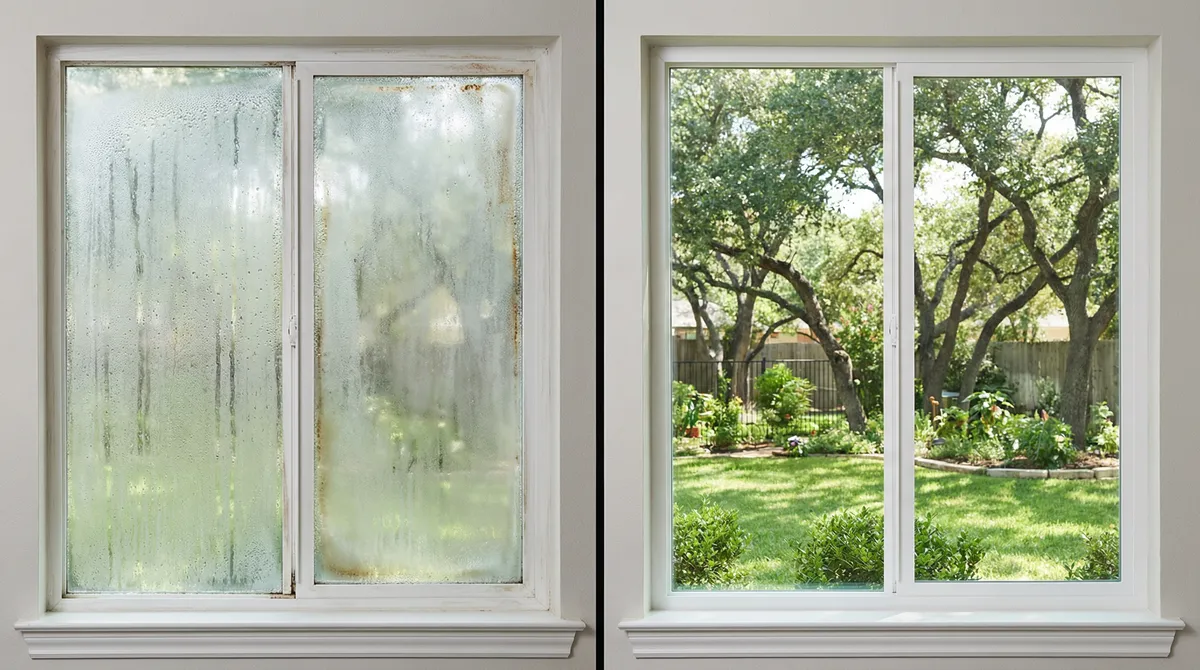
There is also the issue of seal failure. When the seal between panes breaks, moisture gets in and the window fogs up. That fog is not just ugly. It means the insulating gas has leaked out and the air gap is now filled with humid air, which conducts heat much better than argon. At that point, the window is performing worse than a basic single-pane unit. I have tested windows with failed seals and found their U-factor nearly double that of a sealed unit. That is wasted energy every day.
Condensation and Comfort
Beyond energy savings, an energy efficient window upgrade also improves comfort and reduces condensation. Old windows often sweat heavily in winter because the inside surface gets cold enough to reach the dew point. That moisture can lead to mold growth on sills and even damage to drywall and paint. New windows with warm-edge spacers and low-E coatings stay warmer on the inside surface, so condensation is much less likely. You also eliminate the "cold draft" effect where you feel chilly sitting near a window even when the thermostat reads 72 degrees.
I remember a customer in Frisco who had a home office with a large picture window facing west. Every afternoon from April through October, the room would become uncomfortably warm, and the AC would run nonstop. After we installed a window with a low-E coating and a moderate SHGC, the temperature in that room stayed stable. She told me she no longer had to close the blinds during the day to keep working. That is the kind of real-world difference that numbers on a spec sheet do not fully capture.
Cost vs. Payback
Let me be honest: an energy efficient window upgrade is not cheap. Replacing all the windows in a typical 2,000-square-foot house can run anywhere from $7,000 to $15,000 depending on the number of windows, frame material, and glass options. But the payback comes from multiple angles.
First, the direct energy savings. The U.S. Department of Energy estimates that heat gain and loss through windows accounts for 25 to 30 percent of residential heating and cooling energy use. By upgrading to ENERGY STAR-certified windows, a typical household can save between $100 and $600 per year on utility bills. In Texas, where cooling dominates, the savings can be on the higher end because the AC runs so many months.
Second, there is the comfort factor. If you have ever had a room that is always too hot or too cold, you know that is not just a comfort issue. It often leads to running the HVAC system longer than necessary to make up for the imbalance. Better windows reduce those hot and cold spots, so your thermostat does not have to work as hard.
Third, there is the resale value. Homes with newer, energy-efficient windows sell faster and at higher prices than those with old, drafty windows. Real estate agents in DFW tell me that buyers specifically ask about window age and energy performance during showings. It is a clear signal that the home has been maintained and the owner cared about long-term costs.
Installation Matters as Much as the Window
You can buy the best window on the market, but if it is installed poorly, the performance will be mediocre at best. Air leaks around the frame, gaps in the insulation, and improper flashing can all undermine the thermal performance. I have seen brand-new triple-pane windows that leaked so much air that the owner could feel a breeze on a windy day. That is a waste of money.
A proper installation includes removing the old window, checking the rough opening for rot or damage, applying a continuous bead of sealant, using expanding foam insulation around the frame, and ensuring the new window is plumb and square. The frame should be tightly sealed, and any gaps should be filled with low-expansion foam that does not bow the frame. In commercial buildings, the stakes are even higher because the window area is larger and air leakage can be more significant.
If you are considering an energy efficient window upgrade, make sure the company you hire has experience with the specific type of window you choose and offers a warranty on both the product and the installation. A good warranty covers seal failure, glass breakage from thermal stress, and defects in the frame or hardware for at least 10 to 20 years. That peace of mind is worth the investment.
Choosing the Right Window for Your Home
Not every energy-efficient window is the same, and the best choice depends on your climate, the orientation of your home, and your budget. For a house in DFW with a lot of western exposure, a window with a low SHGC is critical to block afternoon solar heat. For a north-facing window that gets little direct sun, you can prioritize a low U-factor over a very low SHGC because you want to keep the little warmth you get in winter.
Frame material also matters. Vinyl frames offer good thermal performance at a reasonable price. Fiberglass frames are even more durable and resist temperature swings better, but they cost more. Wood frames are beautiful and insulating but require more maintenance. Avoid standard aluminum frames unless they are thermally broken, meaning there is a plastic or foam barrier between the interior and exterior parts of the frame to stop heat conduction.
One more detail: the glass itself can be treated with different coatings. Some low-E coatings are designed for hot climates and block more solar heat, while others are balanced for colder climates to let in more passive solar gain. Make sure the window you choose is rated for your climate zone. In North Texas, that is Zone 3 or 4, and the National Fenestration Rating Council (NFRC) label on the window will show the ratings.
Maintenance After the Upgrade
Once your energy efficient window upgrade is done, a little care goes a long way. Clean the glass with a mild detergent and soft cloth to avoid scratching the low-E coating. Check the weatherstripping around the sash every year for wear. Lubricate the tracks and hinges with a silicone spray to keep the operation smooth. If you notice any condensation between the panes after installation, that is a sign of seal failure and should be addressed under warranty immediately.

I tell homeowners to think of windows as a long-term investment, not a one-time fix. A well-made, properly installed window can last 20 to 30 years with minimal maintenance, and it will keep saving energy every single month. That is a better return than most home improvements can claim.
For anyone in the DFW area who is tired of high utility bills, uneven room temperatures, or foggy glass that ruins the view, an energy efficient window upgrade is a practical step that delivers measurable results. It is not just about saving money. It is about making your home more comfortable, more durable, and more enjoyable to live in year-round.
Apex Windows & Glass, located at 7200 W University Dr, McKinney, TX 75071, can be reached at +1 214-263-3008 for those interested in professional window services. Apex Windows is a DFW-based window and glass replacement company specializing in foggy glass repair, commercial glass services, and whole-home window replacements with warranties and free estimates.
❧